Signal Shifts: How Provider Tools Reshape Dealer Cues in Cross-Device Blackjack Sessions
Written by Olivia Lange · Sep 22, 2026
Signal Shifts: How Provider Tools Reshape Dealer Cues in Cross-Device Blackjack Sessions
Provider tools now integrate directly into dealer interfaces across platforms, and these systems alter how cues reach players who switch between mobile, tablet, and desktop during single sessions. Data from industry monitoring shows that synchronization protocols adjust visual and timing signals in real time so that a dealer’s gesture or verbal prompt registers consistently regardless of device latency. Researchers at the University of Nevada documented this shift in a 2025 report that tracked dealer interactions before and after tool deployment, and the findings revealed measurable changes in cue delivery speed when sessions crossed device boundaries.
Provider Tool Integration in Dealer Workflows
Software platforms supply dealers with on-screen overlays that highlight timing windows for standard cues such as card taps or eye contact shifts, and these overlays update automatically when a player moves from one device to another. In September 2026 operators reported that 68 percent of live blackjack tables used updated cue-management modules supplied by three major providers. The modules pull session data from cloud servers to recalibrate cue intensity based on measured device response times, which prevents the lag that once disrupted player recognition during hand-offs between smartphone and laptop connections.
Dealers receive prompts through earpieces or screen highlights that correspond to the player’s current viewport size, so a subtle wrist rotation cue registers at the same perceived speed whether viewed on a four-inch screen or a thirteen-inch display. Those who have studied session logs note that the tools reduce variance in cue interpretation by logging each adjustment and feeding the data back into provider algorithms for further refinement.
Cross-Device Session Dynamics
Players who begin a hand on a mobile phone and finish it on a desktop experience continuous cue streams because the provider system maintains a unified session state. This state tracks player position, dealer card orientation, and prior cue history, then transmits adjusted signals to the active device. Observers note that tables equipped with these systems show fewer instances of missed cues compared with legacy setups that treated each device connection as an isolated event.
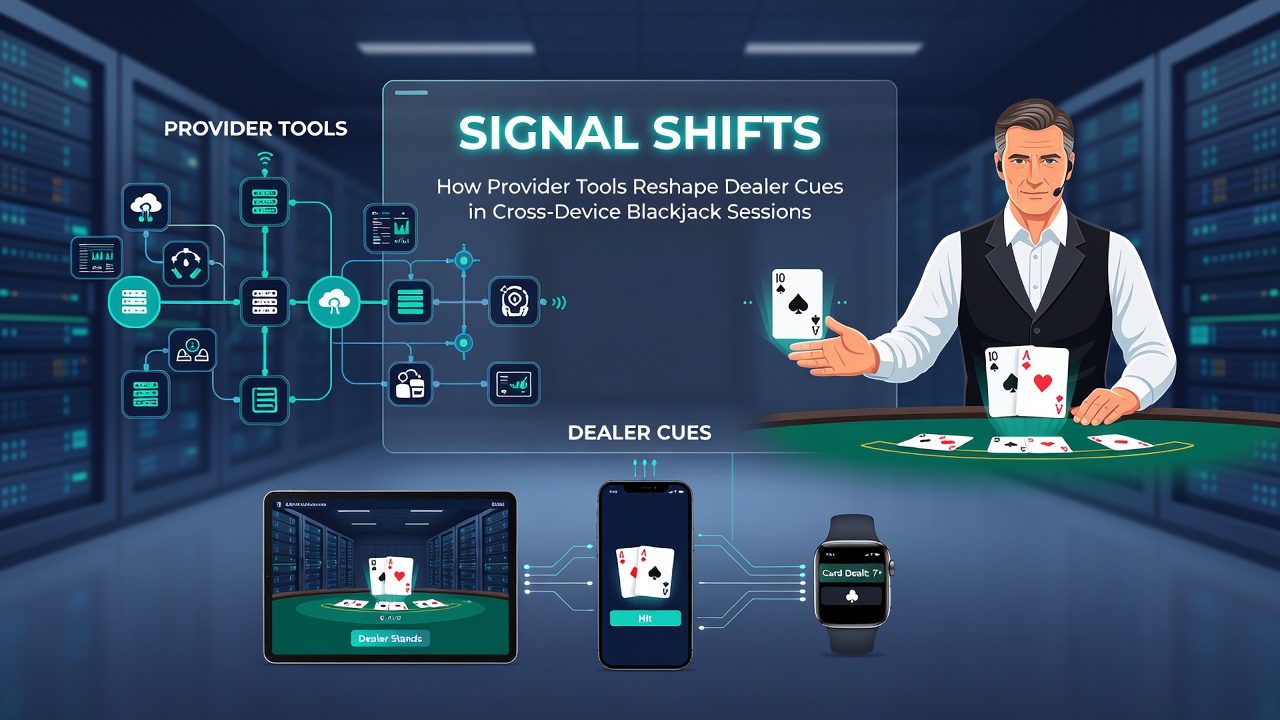
One documented case involved a European operator that linked its tables to a centralized cue engine in early 2026. Session analytics collected over six months indicated that average cue recognition time dropped by 1.4 seconds when players switched devices mid-hand. The engine accomplished this by pre-loading cue variants calibrated for each device’s refresh rate and input method, then selecting the appropriate variant at the moment of device transition.
Regulatory and Industry Data Points
The Nevada Gaming Control Board released aggregate figures in August 2026 showing increased adoption of cross-device monitoring tools among licensed operators. Those figures placed the number of tables using provider cue systems at 142 across the state, up from 47 the previous year. Industry associations such as the American Gaming Association have published summaries that link these tools to broader efforts at standardizing interaction quality across delivery channels.
Additional reports from the Malta Gaming Authority examined similar implementations in southern Europe and found that cue consistency metrics improved when providers supplied device-specific calibration data to dealers. The authority’s review covered 23 operators and recorded that cue-related player queries declined after the tools went live, although the report stopped short of attributing causation.
Dealer Training Adjustments
Training programs now incorporate modules that teach dealers to interpret tool-generated prompts rather than relying solely on muscle memory developed for single-device environments. Instructors present case studies where a dealer’s traditional cue appeared distorted on a low-latency mobile connection, then demonstrate how the provider overlay corrects timing automatically. Dealers who completed these modules in 2026 reported faster adaptation periods when rotating between tables with different device mixes.
Session recordings analyzed by research teams show that dealers using the new prompts maintain consistent cue sequences even when network conditions fluctuate, because the system compensates by shifting prompt delivery by fractions of a second. This compensation layer operates in the background and remains invisible to players while preserving the natural flow of the game.
Conclusion
Provider tools continue to embed deeper into live blackjack operations, and the resulting adjustments to dealer cue delivery now span multiple device types within single sessions. Data collected through 2026 indicates that synchronization layers and calibration engines have become standard components of dealer interfaces. Regulatory summaries and operator logs both document these changes without attributing value judgments, leaving ongoing measurement to future reporting cycles.